10 May 2026 · George du toit · 6 min read
Is Plane Tree Pollen Allergy aggravating my eyes?
The London Plane: a "Pollutant-Sponge" with a Sting in its Tail If you walk through London’s squares in late spring and find your eyes streaming and your throat tickling, you are likely meeting the London Plane (Platanus × acerifolia). Representing over half of the trees in central London, this majestic species is a staple of our urban landscape. However, for allergy sufferers, it poses a unique dual threat: a traditional pollen allergy combined with a physical irritant known as "Plane Tree Du
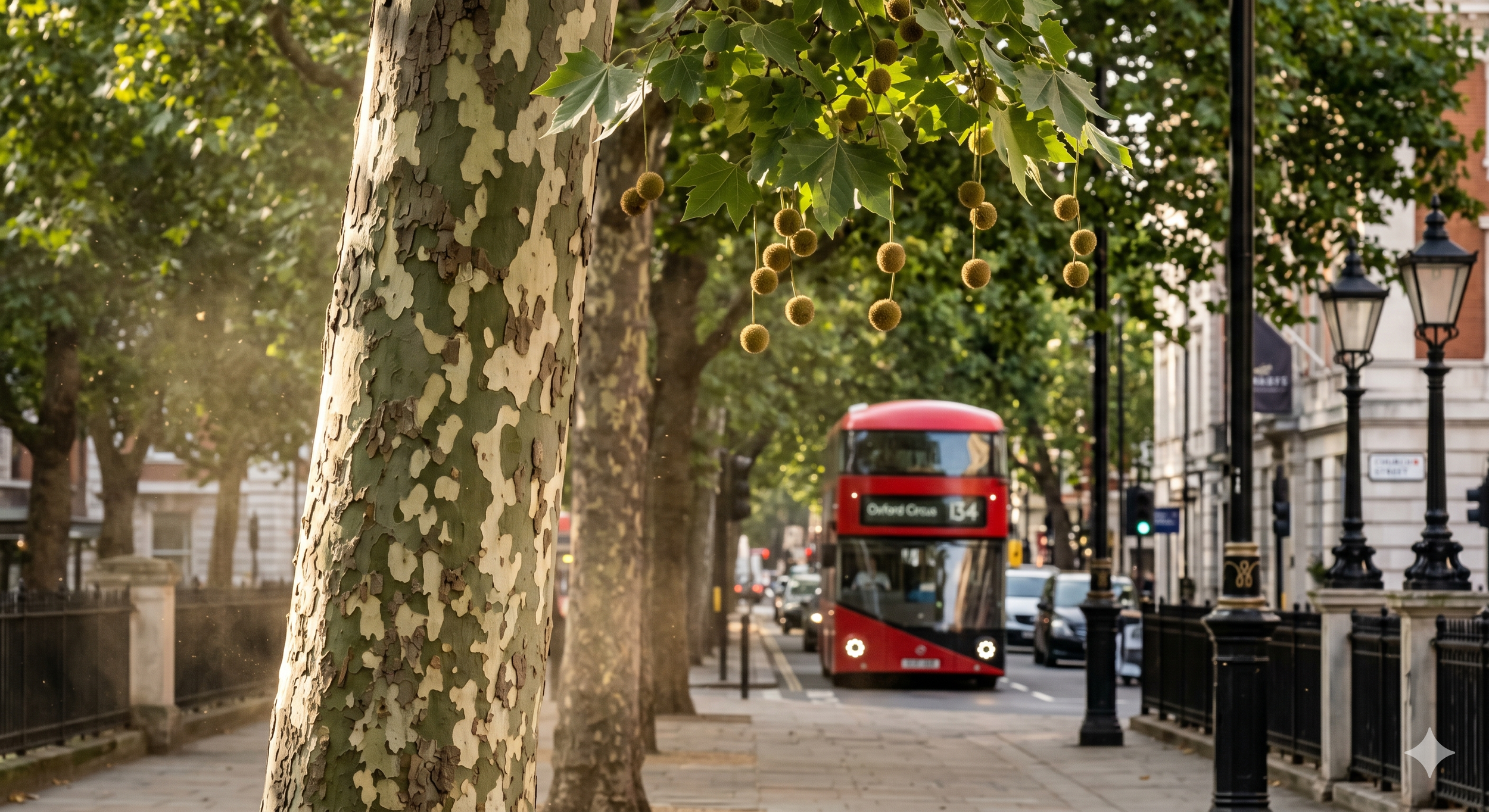
The London Plane: a "Pollutant-Sponge" with a Sting in its Tail
If you walk through London’s squares in late spring and find your eyes streaming and your throat tickling, you are likely meeting the London Plane (Platanus × acerifolia).
Representing over half of the trees in central London, this majestic species is a staple of our urban landscape. However, for allergy sufferers, it poses a unique dual threat: a traditional pollen allergy combined with a physical irritant known as "Plane Tree Dust."
Why So Many Plane Trees in London?
The London Plane is a hybrid, born of a chance encounter in the 17th century between the Oriental Plane (from Southeastern Europe) and the American Sycamore.
It became the darling of Victorian town planners for one primary reason: It is virtually indestructible. During the Industrial Revolution, London was choked by "pea-souper" fogs and heavy coal soot. While most trees suffocated, the London Plane thrived. Its secret? Exfoliating bark. By shedding large bark flakes, the tree literally peels off soot and pollutants that would otherwise clog its pores (lenticels).
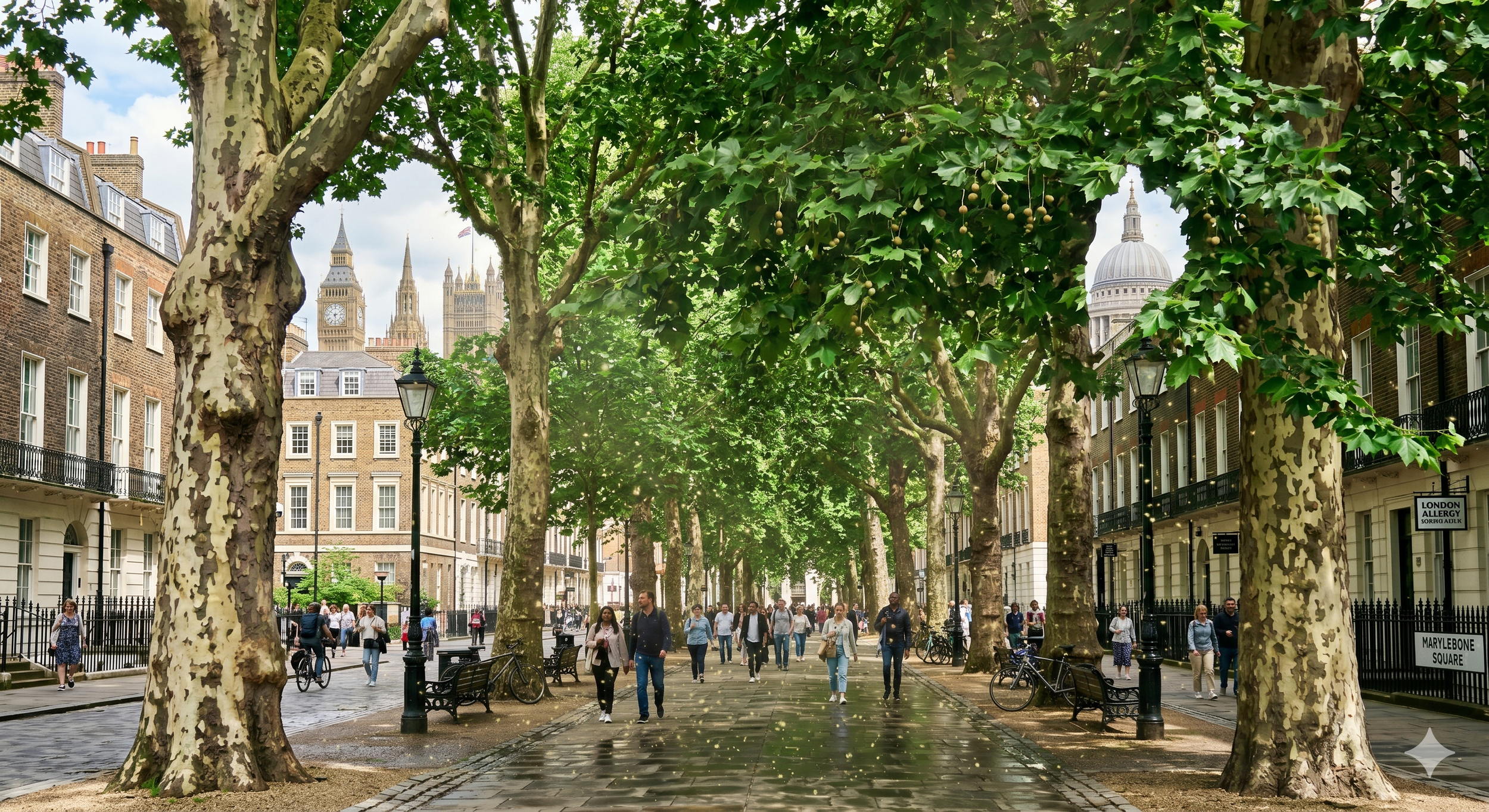
This self-cleaning mechanism—combined with a tolerance for compacted soil and heavy pruning—led to its mass planting in iconic spots like Berkeley Square (1789) and the avenues of Marylebone. Today, it is just as popular in other major cities, including New York (where its leaf is the symbol of the Parks Department), Paris, and Philadelphia.
The "Dual Irritation": Pollen vs. Trichomes (yellow dust)
Unlike many other trees that cause hay fever purely through microscopic pollen, the London Plane irritates in two distinct ways:
- The Pollen (The Allergic Trigger): Like birch or grass, the tree releases wind-borne pollen. This triggers a standard IgE-mediated allergic response: sneezing, a runny nose, and itchy eyes.
- The "Dust" (The Physical Trigger): As the leaves and seed balls (those "pom-poms" hanging from branches) emerge in spring, they are covered in tiny, stiff, umbrella-shaped hairs called trichomes. As these break off, they create a fine yellow dust. These hairs are physically "spiky" and act as a mechanical irritant to the mucous membranes of the eyes and throat.
Symptoms often include:
- "London Eye": Intense grittiness, redness, and watering of the eyes.
- The "Plane Tree Cough": A dry, tickling cough or "scratchy" throat caused by inhaling the physical hairs.
Pollination & Distance travelled
- When: The peak season is typically mid-April to early May, though it can begin as early as March depending on the winter.
- Distance: Unlike the lightweight pollen of birch trees, which can travel for miles, Plane tree pollen is relatively heavy. However, because these trees are planted in high density along London’s streets, the "pollen load" in the immediate vicinity is exceptionally high. You don't need to be in a park to be affected; just walking down a street in Marylebone can be enough.
The Pollen - Pollution Connection
Research (including studies from 2026) suggests a "synergistic effect" between urban pollution and Plane tree symptoms.
- Enhanced Allergenicity: Nitrogen dioxide and ozone can chemically alter the pollen proteins, making them more "aggressive" to the immune system.
- Trapped Particles: Pollutants can stick to the physical trichomes (hairs), meaning when you inhale the "dust," you are also inhaling a concentrated dose of urban toxins deep into your lungs.
Management Tips for Londoners
- Shield Your Eyes: Wrap-around sunglasses are essential during late April and May to block both pollen and physical hairs.
- Rinse Regularly: If you’ve been walking through tree-lined streets, use a simple saline eye wash or "artificial tears" to rinse out the physical irritants.
- Timing: Pollen counts are often highest on dry, breezy days. If a "pollen bomb" is forecast, try to keep windows closed during the day.
- Barrier Creams: Applying a small amount of allergen barrier balm around the nostrils can help trap pollen and larger trichome hairs before they enter the nasal passage.
- Install air purifiers in your bedroom
- Medications: high-dose non-sedating antihistamines, eye drops, and nasal sprays may all be needed
- We offer Pollen Immunotherapy: oral (SLIT) and subcutaneous (SCIT).
The London Plane is a remarkable survivor that helps cool our city and clean our air - but for three weeks a year, it certainly demands our respect (and perhaps a few extra antihistamines).
Frequently Asked Questions
-
Pollen Characteristics: The Science of the "Spiky" Grain
While the London Plane's physical hairs (trichomes) cause immediate mechanical irritation, the pollen grains themselves are the primary cause of the late-spring "hay fever" response.
What Does it Look Like?
Under a microscope, London Plane pollen is distinct. It is tricolpate, meaning it has three long grooves (apertures) running along its surface.
Size: It is relatively mid-sized for pollen, typically measuring around 20–25 micrometres ($20–25\,\mu\text{m}$).
Surface: Unlike the smooth grains of some species, the surface (exine) of Plane pollen has a delicate, net-like (reticulate) pattern.
Weight: It is heavier than the buoyant pollen of the Birch tree. This means that while Birch pollen can travel hundreds of miles from Scandinavia to London, Plane pollen tends to settle more quickly, leading to "hotspots" of high concentration directly under the tree canopies in London’s squares.
Is it Unique or Related to Other Trees?
In the world of allergy, we look closely at cross-reactivity—when the immune system confuses the proteins of one species with another.
Taxonomic Isolation: The London Plane belongs to the Platanaceae family. It is botanically quite distant from the most common UK "allergy" trees, such as the Birch, Alder, and Hazel (which belong to the Betulaceae family) or the Oak.
The "Sycamore" Confusion: In the UK, people often confuse the London Plane with the Sycamore (Acer pseudoplatanus). While they look similar to the naked eye, they are unrelated. The Sycamore is a member of the Soapberry family and is insect-pollinated, meaning it rarely causes significant hay fever compared to the wind-pollinated London Plane.
Cross-Reactivity Risks: Interestingly, if you are allergic to London Plane pollen, you may also experience Pollen-Food Syndrome (Oral Allergy Syndrome). The proteins in Plane pollen share similarities with:
Hazelnuts and Peanuts
Celery
Peaches and Apples
Lettuce
This means some Londoners might find their mouth itches when eating a salad or a peach specifically during the weeks the Plane trees are in bloom
-
London isn't the only "Plane-choked" city. It is a dominant urban tree in Madrid, Barcelona, and Melbourne.
In Mediterranean cities, the Plane tree season is often much more explosive due to the warmer, drier climate, which allows the pollen to stay airborne longer. London’s humidity and frequent spring showers often help "wash" the heavy pollen and irritating trichomes out of the air, providing temporary relief—until the pavement dries and the wind picks the dust back up.
-
In the world of allergy, we look closely at cross-reactivity - when the immune system confuses the proteins of one species with another.
Taxonomic Isolation: The London Plane belongs to the Platanaceae family. It is botanically quite distant from the most common UK "allergy" trees, such as the Birch, Alder, and Hazel (which belong to the Betulaceae family) or the Oak.
The "Sycamore" Confusion: In the UK, people often confuse the London Plane with the Sycamore (Acer pseudoplatanus). While they look similar to the naked eye, they are unrelated. The Sycamore is a member of the Soapberry family and is insect-pollinated, meaning it rarely causes significant hay fever compared to the wind-pollinated London Plane.
Worried About Allergies? Let’s Help You Get Answers
If your child is showing signs of a food, pollen, or skin allergy, early diagnosis is key. At London Allergy Consultants, our expert team provides trusted, evidence-based care tailored to your child’s needs. From testing to treatment plans, we guide you every step of the way.

London Allergy Consultants
London Allergy Consultants is a leading UK centre for diagnosing and treating food and airborne allergies in children and young people.
Get in Touch
0330 678 5168