8 February 2026 · George du toit · 8 min read
Where can I access Pollen Immunotherapy (SLIT or SCIT) in the UK?
Pollen immunotherapy benefits include: * Helps reshape the disease process toward long-term tolerance * Prevents allergic rhinitis from progressing to asthma and may reduce new allergies * Ongoing relief even after treatment ends. * Improves symptom control while reducing reliance on medications. Isn’t that amazing? * It has been a very wet winter and Spring in the UK, so brace for a high pollen summer season! Tell me more about pollen SLIT Pollen Immunotherapy: * If your child’s previ

Pollen immunotherapy benefits include:
- Helps reshape the disease process toward long-term tolerance
- Prevents allergic rhinitis from progressing to asthma and may reduce new allergies
- Ongoing relief even after treatment ends.
- Improves symptom control while reducing reliance on medications. Isn’t that amazing?
- It has been a very wet winter and Spring in the UK, so brace for a high pollen summer season!
Tell me more about pollen SLIT Pollen Immunotherapy:
- If your child’s previous summer seasons were troublesome, with insufficient relief provided by frontline medications such as non-sedating antihistamines and nasal sprays, please consider initiating immunotherapy, namely SLIT (Sublingual Immunotherapy) or SCIT (Subcutaneous Immunotherapy).
- Pollen immunotherapy is a type of treatment for hay fever (allergic rhinitis) that involves administering specific aeroallergens, such as grass and tree pollen, to build tolerance over time.
- SLIT therapy can reduce hay fever symptoms and the need for medication and is typically recommended for those with moderate to severe allergies who have not had success with other treatments.
- In some patients, immunotherapy can also help moderate Oral Allergy Syndrome symptoms and may delay the onset of allergic asthma symptoms in children.
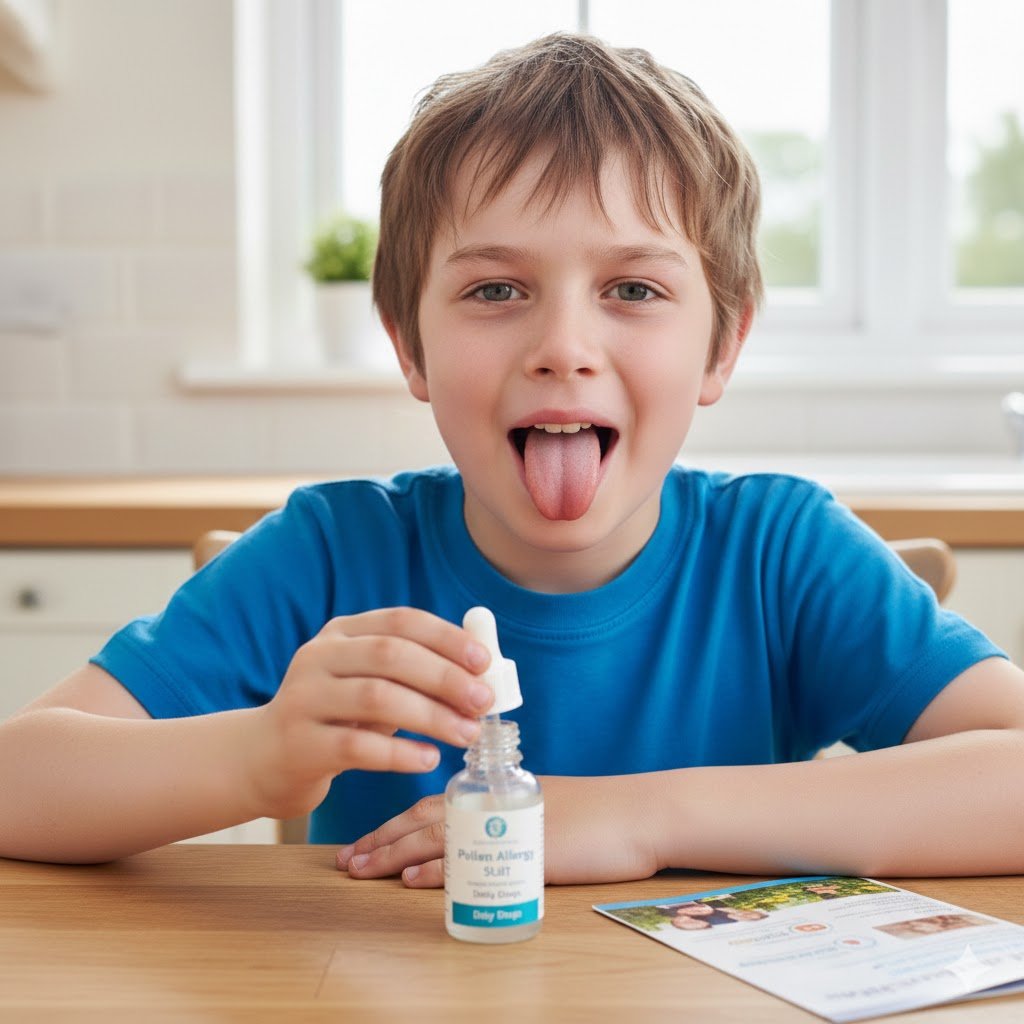
- SLIT is taken daily, and the duration of therapy is typically three years.
- Children older than 6 years can usually tolerate dissolving a tasteless tablet under their tongue before swallowing it each day.
- SLIT can also be used to moderate allergic reactions to house dust mites or mould.
Is SCIT to pollen also available in your clinic?
- Yes, we offer Subcutaneous Immunotherapy (SCIT) as part of our ACE Service.
- SCIT is an evidence-based treatment for allergic rhinitis and asthma, in which graded doses of allergen extracts are administered to induce immunological tolerance and reduce symptoms.
- Research shows that SCIT can reduce symptom scores, reduce the need for medication, and improve quality of life, with lasting benefits even after treatment discontinuation.
- While local injection site reactions are common, systemic reactions are less frequent. It's important to note that poorly controlled asthma can increase the risk of severe adverse events.
Frequently Asked Questions
-
Important Realities of NHS Access
Timing: For pollen allergies, treatment usually needs to start in the autumn or winter (October–December) so that your body is prepared before the spring pollen season begins. It may therefore be too late to set up a pathway for the summer of 2026.
Availability on the NHS: Access is "postcode dependent." Some Integrated Care Boards (ICBs) have stricter funding criteria than others.
You will need to ask your GP to refer you to your nearest NHS clinic, for clinics that do provide immunotherapy please check - the BSACI (British Society for Allergy & Clinical Immunology) Clinic Finder to see where your nearest NHS specialist allergy service is located.
-
At London Allergy Consultants, we are proud to be one of the UK’s largest and most experienced providers of pollen immunotherapy for children.
Our team has been at the forefront of this field for years, not only in private practice but through long-standing leadership and clinical involvement within the NHS.
We understand that severe hay fever is more than just a seasonal nuisance—it can impact a child’s schooling, sleep, and overall quality of life. Because we have extensive experience in initiating and managing ongoing care across a wide range of treatment options, we are able to provide a highly personalized approach for every family.
-
Logistical considerations may apply:
Different licenses may apply
Patients may be needle phobic, SLIT will suit them better
Patients my be more unlikely to follow a daily regimen, SCIT will suit them better
Efficacy:
SCIT and SLIT are both effective for pollen allergies, with most comparative trials showing similar reductions in symptom and medication scores for both modalities.
SCIT may demonstrate earlier onset of efficacy and, in some studies, slightly greater clinical benefit, but the majority of head-to-head trials are underpowered and do not show statistically significant differences between SCIT and SLIT for pollen allergy endpoints.
SCIT is associated with a higher risk of systemic reactions, including rare but potentially severe anaphylaxis, whereas SLIT has a lower prevalence of systemic reactions and is generally considered safer, allowing for daily home administration without direct physician oversight.
Local reactions are common with both, but systemic reactions are more frequent with SCIT.
The choice between SCIT and SLIT should be individualized, taking into account efficacy, safety profile, patient preference, and logistical considerations. We will discuss this all in detail during your assessment cisits in our London Allergy Consultant clinics.
-
Please book an appointment in clinic.
Ideally this will be face-to-face, we can then perform SPT and if needed blood testing.
If this is not possible, we are happy to perform remote Zoom appointments, and home blood testing using the ALEX3 test can be set up by our office.
WE can then discuss treatment and product options and how best, and safest, to commece treatment.
-
Sublingual immunotherapy is safer than subcutaneous immunotherapy for the treatment of hay fever (allergic rhinitis), with most adverse reactions being mild, transient, and limited to local oral or gastrointestinal symptoms such as itching or dyspepsia; severe systemic reactions and anaphylaxis are exceedingly rare and have not been reported in large randomised controlled trials or systematic reviews.
Sublingual immunotherapy can be administered at home after the first supervised dose, and does not require emergency preparedness for systemic reactions.
Subcutaneous immunotherapy carries a higher risk of systemic reactions, including rare but potentially life-threatening anaphylaxis, with a rate of approximately 0.1% per injection visit and one anaphylactic event per 160,000 injections; therefore, it must be administered in a medical setting with observation and access to emergency treatment.
Most reactions are mild (local injection site reactions), but systemic hypersensitivity episodes are more frequent than with sublingual immunotherapy.
Both modalities are effective, but the safety profile of sublingual immunotherapy is superior, making it preferable for patients at higher risk of systemic reactions or those seeking neele-free convenience.
-
In the UK, the Medicines and Healthcare products Regulatory Agency (MHRA) has licensed several products for both sublingual (under the tongue) and subcutaneous (injection) use.
1. Sublingual Immunotherapy (SLIT)
These are daily tablets or drops taken at home after the first dose is supervised by a specialist.
Grazax
ALK-Abelló
Grass Pollen (Timothy Grass)
5 to 65 years
Itulazax
ALK-AbellóTree Pollen (Birch, Alder, Hazel)
18 to 65 years
Acarizax
ALK-Abelló
House Dust Mite
12 to 65 years
2. Subcutaneous Immunotherapy (SCIT)
These are injections ("allergy shots") administered by a specialist in a clinic with resuscitation facilities.
Allergy Therapeutics
Grass Pollen
6 years and over
Pollinex Tree
Allergy Therapeutics
Tree Pollen
6 years and over
Alutard SQ
ALK-AbellóGrass, Tree, or Dust Mite
5 years and over
-
Pollen, Food Allergy, and Hay Fever
Diagnosis and Management of Pollen Food Allergy Syndrome to Nuts (2024)
Journal: The Journal of Allergy and Clinical Immunology: In Practice
Contribution: This clinical framework helps clinicians distinguish between a life-threatening primary nut allergy and Pollen Food Allergy Syndrome (PFAS). It provides clarity on when patients with hay fever can safely consume certain nuts (like hazelnuts or almonds) if they are processed or heated, which typically destroys the pollen-like proteins.
EAACI Guidelines on the Diagnosis of IgE-mediated Food Allergy (2023)
Journal: Allergy
Contribution: These international guidelines define the use of Component Resolved Diagnostics (CRD). This breakthrough technology allows doctors to see if a patient is reacting to "pollen-mimicking" proteins (often causing mild hay fever-related symptoms) or stable "storage proteins" that carry a higher risk of severe allergic reactions.
BSACI Guideline for the Diagnosis and Management of Pollen Food Syndrome in the UK (2022)
Journal: Clinical & Experimental Allergy
Contribution: Dr. Foong and Prof. Du Toit contributed to this essential UK roadmap for managing Pollen Food Syndrome (PFS). It offers practical advice for patients who experience an itchy mouth or throat after eating raw fruits or vegetables due to their underlying hay fever.
Asthma, Food Allergy, and How They Relate to Each Other (2017)
Journal: Frontiers in Pediatrics
Contribution: A seminal review of the "Allergic March." This paper details how early-onset hay fever and pollen sensitization can be early warning signs that influence the severity of a child’s asthma and their risk profile for developing multiple food allergies.
EAACI Guidelines on Allergen Immunotherapy: Allergic Rhinoconjunctivitis (2017)
Journal: Allergy
Contribution: Prof. Du Toit co-authored these foundational guidelines confirming that Allergen Immunotherapy (AIT)—such as sublingual hay fever drops—is a disease-modifying treatment. It doesn't just mask symptoms; it retrains the immune system to tolerate pollen, which can significantly improve a patient’s overall quality of life.
Pollen Food Syndrome amongst Children with Seasonal Allergic Rhinitis (2015)
Journal: Pediatric Allergy and Immunology
Contribution: This study was one of the first to highlight how common Pollen Food Syndrome is in children with hay fever. It showed that as children get older, their hay fever frequently leads to new reactions to raw fruits and nuts, identifying a clear need for early screening in allergy clinics.
-
The cost of your treatment course will depend on the regimen required (mono or poly therapy) and exact product you would like to use.
Please do contact Louise in our London Allergy Consultant Office to get the exact current pricing and to learn about payment plans.
Our package of thereapy inlcudes dealing with any adverse reactions and treatment related questions along the journey. We will check in after year and year two to see all is well, unless we communicare long the journey, which is typically very smooth.
Comparison: SLIT vs SCIT Immunotherapy
| Feature | SLIT (Sublingual) | SCIT (Subcutaneous) |
|---|---|---|
| Method | Oral: A tablet or drops held under the tongue, then swallowed. | Injection: A small injection into the fatty tissue of the upper arm. |
| Where it happens | Home-based: First dose as Video or clinic; all subsequent doses are taken at home. | Clinic-based: Every dose must be administered by a specialist in-clinic. |
| Commitment | Daily: Must be taken every day for the duration of the course. | Monthly: Typically four 'shots' weeks apart, per year. |
| Duration | Typically 3 years for long-term desensitisation. | Typically 3 years for long-term desensitisation. |
| UK Products | Tablets: Grazax, Itulazax, Acarizax. Drops: Oraltek (allergen mixes available). | Injections: Alutard SQ, Pollinex Quattro. |
| Common Side Effects | Localised mouth itching, lip swelling, or a mild "scratchy" throat. | Localised redness, itching, or swelling at the injection site. |
| Observation | First dose requires 30 minutes of observation in our clinic. | Every dose requires 60 minutes of observation in our ACE clinic. |
| Age | Generally licensed from age 5+. | Generally licensed from age 5+. |
Which treatment is right for my child?
The choice between SLIT and SCIT depends on your family's lifestyle and your child's preferences.
- Choose SLIT if: You prefer the convenience of home-based treatment and wish to avoid injections. It requires a level of daily discipline.
- Choose SCIT if: You prefer not to manage daily medication at home and would rather have the treatment managed entirely by our clinical team at ACE; four visits each year.
Worried About Allergies? Let’s Help You Get Answers
If your child is showing signs of a food, pollen, or skin allergy, early diagnosis is key. At London Allergy Consultants, our expert team provides trusted, evidence-based care tailored to your child’s needs. From testing to treatment plans, we guide you every step of the way.

London Allergy Consultants
London Allergy Consultants is a leading UK centre for diagnosing and treating food and airborne allergies in children and young people.