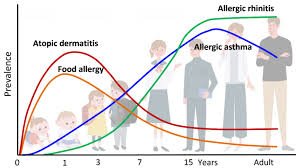
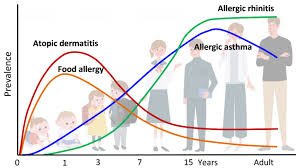
The Allergic March
The allergic march, aka the atopic march, is a concept describing the possible progression of allergies in your child. Allergic diseases are usually multi-system in nature, so it is not uncommon for infants with eczema to go on to develop one or more of food allergy, asthma, hay fever, and oral allergy syndrome. Whilst this is true at a study population level, it is very hard to predict the likely course for each child.
Whilst it’s not possible to alter any genetic predisposition, it does make sense to minimise the risk of progressing along this march through modifying environmental factors. The two most significant disease-modifying interventions are the best eczema control and the introduction of common and relevant food allergens for your child. Healthy living strategies will help nurture the gut and skin microbiomes, so these seem prudent as well.
It may be that early mite and pollen immunotherapies may decrease allergic respiratory disease, but such studies remain under investigation.
Pollution and mould are bad forall lungs, allergic and non-allergic alike, so steps to reduce this, e.g. air purifiers in bedrooms, seem wise.
As with asthma, there are many ‘eczemas’ - severe eczema, oozing, wheeping, crusting, staph-infected, and which are often on exposed skin areas (hands, feet, face, head and neck) seem to be most strongly associated with the development of food allergy, so early and proactive treatment of this is warranted.
We have separate posts regarding optimising skin control, restoring the gut biome and early weaning, so if the topic is of interest or concern to you, please read those as well.
What Is CMPA?
CMPA, also referred to as cow’s milk allergy, is an immune reaction to proteins found in cow’s milk. These proteins, such as casein and whey, can cause inflammation and irritation in various parts of the body.
Unlike lactose intolerance, which is a digestive issue involving sugar in milk, CMPA is an allergic response to the protein in cow’s milk. This means even small amounts of milk protein can trigger symptoms.
CMPA may develop in formula-fed babies and, in some cases, even in breastfed babies.
CMPA Symptoms to Watch For
Symptoms of CMPA can vary widely from baby to baby and may affect multiple systems in the body.
One of the most common signs is skin irritation, including CMPA rash, which presents as red, dry, or itchy patches, sometimes appearing as eczema or hives. These rashes may develop around the face, neck, or folds of the skin. In some cases, facial swelling may also occur after feeding. Digestive symptoms are also frequent and can be misleading, often resembling reflux or colic. Babies may vomit after feeding, experience frequent diarrhoea, or show signs of constipation. Parents notice that their baby cries excessively or arches their back in pain during or after feeds—behaviours that often indicate stomach discomfort or acid reflux associated with dairy allergy. Some babies also show respiratory symptoms, such as a new-onset, post-feed, persistent cough, wheezing, nasal congestion, or noisy breathing. Though these are less common than skin or digestive symptoms, they can appear in moderate to severe cases. Another concern is feeding difficulty. Babies with CMPA may refuse to feed, cry during feeding, or fail to gain weight as expected, all of which suggest that feeding is causing discomfort or pain.
Blood or mucus in the stool is a red flag for cow’s milk protein allergy, although this is a non-IgE variant, known as Cow's Milk Protein-Induced Colitis (CMPIE).
Another form of non-IgE CMP sensitivity is Food protein induced Enterocolitis syndrome (FPIES), typically presenting with profuse vomiting 2-4 hours after food intake. A rash is not noted with this variant.
Frequently Asked Questions
-
The typical symptoms of cow's milk allergy (CMA) in infants and young children vary depending on whether the allergy is IgE-mediated or non-IgE-mediated.
IgE-mediated CMA usually presents with acute onset symptoms (within 2 hours of exposure), including vomiting, urticaria, angioedema, erythema, lethargy, and respiratory symptoms such as wheezing or stridor. These symptoms are reproducible with subsequent exposures to cow’s milk protein and typically resolve within hours.
Non-IgE-mediated CMA is characterized by delayed onset symptoms (hours to days after exposure), most commonly involving the gastrointestinal tract. These include vomiting, diarrhea, blood in stools (allergic proctocolitis), chronic diarrhea, regurgitation, abdominal pain, failure to thrive, and persistent crying or irritability. Cutaneous symptoms such as eczema and, less commonly, respiratory symptoms may also occur. The clinical presentation can overlap with common infant symptoms, making diagnosis challenging.
Most infants with CMA have symptoms involving more than one organ system, with gastrointestinal (50–60%), cutaneous (50–60%), and respiratory (20–30%) manifestations being most frequent. Symptoms may be immediate (within 1 hour) or delayed (after 1 hour) following ingestion of cow’s milk protein.
It is important to note that many of these symptoms are nonspecific and common in infancy, so diagnosis should be confirmed by elimination and challenge procedures to avoid misdiagnosis.
-
Testing for cow's milk allergy involves a combination of clinical assessment and diagnostic procedures. The process begins with a detailed clinical history and physical examination to assess the likelihood of cow's milk allergy and to characterize the type of reaction (IgE-mediated, non-IgE-mediated, or mixed).
For IgE-mediated cow's milk allergy, the following tests are used:
• Skin prick testing (SPT) with commercial cow's milk extracts or, if unavailable, with fresh milk (prick-prick method). A wheal ≥3 mm larger than the negative control is considered positive. SPT is sensitive but not highly specific, and a negative result has a high negative predictive value, especially in infants.[4][5]
• Serum cow's milk-specific IgE measurement (using assays such as ImmunoCAP or similar). Elevated levels support sensitization, but the predictive value depends on the cutoff used and the clinical context. For example, a specific IgE level ≥2.5 kU/L has a high positive predictive value in infants with a convincing history. However, sensitization alone does not confirm clinical allergy.
• Component-resolved diagnostics (e.g., measuring IgE to casein, α-lactalbumin, β-lactoglobulin) can refine risk assessment and may help predict the likelihood of reaction during oral food challenge.
For non-IgE-mediated cow's milk allergy, SPT and specific IgE are often negative. In these cases, atopy patch testing and emerging biomarkers (e.g., faecal calprotectin) have been studied, but their diagnostic utility is limited and not standardized.
The gold standard for diagnosis is the oral food challenge (OFC), typically performed in a supervised setting after a period of elimination. This is especially important when test results are equivocal or when non-IgE-mediated allergy is suspected.
Allergy Societies emphasize that OFC is required to confirm the diagnosis in most cases, as neither SPT nor specific IgE alone is definitive.
In summary, testing for cow's milk allergy is based on clinical history, SPT, serum-specific IgE, and, when necessary, oral food challenge, with the latter being the definitive diagnostic tool.
Please do get in touch with us if you require testing, we offer all the above modalities.
-
In the UK, if an infant has a confirmed or suspected cow's milk allergy, the following milk options are generally considered safe and are recommended under medical supervision:
1. Breastfeeding: Breast milk is the ideal source of nutrition for babies. If a breastfed infant is reacting to cow's milk protein, the mother may be advised to eliminate cow's milk and dairy products from her own diet, but we try not to do this if possible as it is more natural for the allergic infatnt to ‘see’ the cows milk protein through moms diet.
2. Hypoallergenic Formulas: For formula-fed babies, a healthcare professional we will prescribe a special "hypoallergenic" formula. These are not available over the counter and are specifically designed for infants with cow's milk allergy. There are two main types of hypoallergenic formulas:
Extensively Hydrolysed Formulas (EHF): These are the first-line treatment for most cases of mild to moderate cow's milk allergy. The cow's milk proteins have been broken down into smaller pieces, making them less likely to trigger an allergic reaction.
Amino Acid Formulas (AAF): These are used for infants who have severe allergic reactions or who do not tolerate an extensively hydrolysed formula. The protein in these formulas is completely broken down into its individual building blocks (amino acids) and is not based on cow's milk.
Soya-based Formulas (for some infants over 6 months):
Soya-based formulas are not suitable as a first-line alternative for infants under six months of age. For infants over six months, a dietitian may advise on whether a soya formula is appropriate, as some babies with a cow's milk allergy can also react to soya protein. These are hard to access in the UK.
Rice based milk formula. This is a palatable and safe option now available in the UK, trading as Arize. Arize contains extensively hydrolyzed rice protein instead of cow's milk protein, is hypoallergenic, and can be used from birth onwards.
What to Avoid:
Standard Cow's Milk Formula: This is not safe and will cause an allergic reaction.
Other Mammalian Milks: Milks from other animals like goats and sheep are generally not suitable as they contain similar proteins to cow's milk and are likely to cause a reaction.
Lactose-free Milk: This is not a substitute for hypoallergenic formula as it still contains the cow's milk protein that causes the allergy.
Plant-based Milk Alternatives (e.g., oat, almond, coconut, hemp): These are not nutritionally complete for babies and should not be used as a main milk drink for infants, especially under the age of one. They can, however, be used in small amounts in cooking or on cereal for babies over six months, provided they are fortified with calcium and other essential nutrients, and with the guidance of a healthcare professional.
Rice Milk: Due to its naturally occurring arsenic content, rice milk should not be given to children under 4.5 years old. description
-
Transfer of Cow's Milk Components
Yes, transfer occurs: Components of cow's milk, specifically cow's milk proteins such as beta-lactoglobulin and casein-derived peptides, can pass into human breast milk after a mother consumes dairy products.
Mechanism: The process involves the digestion of cow's milk proteins in the mother's gut, absorption into her bloodstream, and subsequent transfer into the breast milk, often as peptide fragments rather than fully intact proteins. The most commonly detected protein is beta$-lactoglobulin, but casein fragments may also be present.
Concentration and Allergy Risk
Trace Amounts: The concentration of these proteins in breast milk is generally very low and highly variable.
Low Risk for Most Infants: For most infants, these trace amounts are well below the threshold required to trigger an allergic reaction, even in those diagnosed with Cow's Milk Allergy (CMA).
Rare Sensitisation: In rare cases, clinical challenge studies have demonstrated that highly sensitive infants with proven CMA may react to these minimal levels of transferred proteins.
Overall Probability: The overall probability that a single breastfeed contains sufficient antigen to elicit an acute allergic reaction in a sensitive infant is considered low, with the majority of breast milk samples containing minimal or undetectable levels of these proteins.
Worried About Allergies? Let’s Help You Get Answers
If your child is showing signs of a food, pollen, or skin allergy, early diagnosis is key. At London Allergy Consultants, our expert team provides trusted, evidence-based care tailored to your child’s needs. From testing to treatment plans, we guide you every step of the way.

London Allergy Consultants
London Allergy Consultants is a leading UK centre for diagnosing and treating food and airborne allergies in children and young people.
The allergic march, aka the atopic march, is a concept describing the possible progression of allergies through childhood. Allergic diseases are usually multi-system in nature, so it is not uncommon for infants with eczema to go on to develop one or more of food allergy, asthma, hay fever, and oral allergy syndrome. It can be so disheartening for parents to see these diseases develop, one following the other, Whilst this is true at a study population level, it is very hard to predict the likely course for each child.